Archive for the ‘Dogs’ Category

Whelping Survival Guide Part 1: All about Pregnancy

So, your bitch has met with the stud dog – hooray! But what happens next? What do you have to do? Is there anything to watch out for? No need to worry – read on for all the answers you need!

How long is her pregnancy?

The average pregnancy is 63 days from the first mating; however, the bitch’s season is quite long, sperm can survive inside for quite a while, and so there is always some natural variability. We certainly wouldn’t expect her to produce any puppies before 56 days, and if she’s reached 73 without anything, that suggests a problem with the dates, or uterine inertia.

How do I know if she’s pregnant?

Diagnosing pregnancy in the bitch is not as easy as in humans. This is mainly because the bitch’s body prepares for pregnancy after every season, whether or not there are actually any pups present. So, a progesterone test (for example) is essentially useless – the bitch thinks she’s pregnant anyway, every single time! There is one slightly dubious and two reliable and widely available methods we can use to determine pregnancy:

Palpationan experienced vet can sometimes feel the puppies between 25 and 30 days after conception – however, a fat, tense or anxious, or large breed bitch can make this really difficult. As a result, you can get false negatives, and occasionally even false positives. We do not, therefore, recommend it!

Relaxin Blood Test although progesterone tests are useless, there are other hormones in pregnancy! The Relaxin test is reliable and accurate, and can be used from 25-30 days post conception.

Ultrasound Scan this is the most common and most reliable method. It is first reliable at 25-30 days and at this time the heartbeats can usually be seen quite clearly. In the hands of an experienced vet, sometimes it’s possible to say that she is in pup from three weeks, but it’s impossible to say with certainty that she isn’t at this age. Ultrasound scans also allow us to measure the size of the puppies, and work out how old they are. This can help us narrow down the due date if a bitch was mated several times! However, the ultrasound scan can only give you a rough idea of the numbers – an accurate count of foetuses is not possible.

Are there any health precautions I need to take?

You want the puppies to be as healthy as possible, so making sure she has a good diet and suitable preventative care are really important.

Dieta suitable fully balanced diet is ideal; we’d generally recommend against a raw food diet in pregnancy as it’s very hard to get the nutrient levels right. We also STRONGLY advise against giving any calcium supplementation – doing so, ironically, increases the risk of eclampsia (see in Part 2). In terms of volume, she doesn’t really need any more calories until the last 2 weeks or so and, if you overfeed, there’s a risk that she’ll be too fat, or the pups will be too big, for her to give birth normally. Of course, after birth, she needs more or less as much as she can get to make milk for her puppies!

Vaccination puppies are protected for the first 4-6 weeks of life by their mother’s immune system, so it’s important that she is fully up to date with vaccinations, ideally before she gets pregnant. If her vaccination status will lapse during her pregnancy, you can give her a booster, but it’s probably better to boost her 3-4 weeks before she goes to the dog. If Canine Herpes (a nasty infection that is usually fatal to puppies) is a problem, there is a short-acting vaccine given in pregnancy that will protect them – but we don’t think it’s usually necessary.

Wormingsome nasty roundworms can invade a puppy through the placenta, and also through the milk. During pregnancy, dormant worms may wake up and become active, so worming with a puppy-safe wormer during pregnancy is vitally important. Talk to us for advice on the dosage because it’s a bit different from normal 3-monthly doses!

How should I prepare as she gets near her time?

In the last couple of weeks of pregnancy, introduce her to the area where you want her to whelp. Remember, she’ll only whelp down somewhere she feels comfortable, safe and secure! Ideally, a box she can hide away in, with comfortable bedding (towels are good – they’re going to get messy! – and newspaper underneath is a must), nice and warm and free from draughts.

In Part 2, we’ll look at the whelping process itself.

If you’ve got any other questions, feel free to call us for advice. If you think something’s going wrong, call us any time, 24/7, and talk to one of our vets.
 

How do I decide when the time has come to put my dog to sleep?

Owning a dog is a terrible responsibility – we care for them, and look after them, and love them, but sometimes the best way to show that love is to be able to say goodbye when the pain or the suffering becomes too much. However, that can be a really hard call to make – especially as, sadly, dogs rarely die peacefully in their sleep. Normally, they struggle on and on, with life becoming increasingly difficult and painful – and that’s something we need to be able to help with. 

So, how do I decide?

The first thing to do is to think about your dog, as an individual. It is useful to do this before they become old and ill, but you can do it at any time. Firstly, make a list of all the things your dog loves doing most – the things that their life wouldn’t be worth living without. This will, of course, vary from dog to dog – which is why it’s important that you do this; even as vets, we can’t do it for you!

Then, secondly, make a list of the things they really hate, the things they truly cannot stand.

When they become old, or ill, you’ll be able to take those lists out and compare them with your dog’s current life.

  • Are they still having a good quality of life?
  • Can they still do the things they love?
  • Are they able to avoid (mostly!) doing the things they hate?
  • Are they getting more good days than bad?

If the answer to any of these questions is no, then you need to take a long think about their quality of life and decide if it’s time to “call it a day”.

How do I prepare myself and my family?

It is usually best to get everyone on-side – serious disagreement over this is toxic. If necessary, bring your family and your pet to the surgery, and one of our vets will be able to talk to you about quality of life issues, to help everyone make a collective decision.

In the case of children, it’s really important to make sure they’re kept “in the loop” – even if you decide that they aren’t ready to be involved in planning the decision, make sure you “signpost” it really well – that the dog is really ill, and (for example) very old; or that they are in a lot of pain or suffering. You may well find that doing this helps you to gain some perspective as well.

What will happen when we decide to have them put to sleep?

Although it’s a common turn of phrase, “put to sleep” isn’t always a helpful phrase (we’ll discuss why a little later). The technical term is euthanasia, which literally means “a good death”.

If possible, make an appointment well in advance – that way we can arrange to have the staff and time to make sure that everything goes smoothly. If your dog is stressed or anxious, we may give them a sedative to help them settle, and we’ll often leave you alone with them for a few minutes while that starts to work. Then, a small area of fur (usually on a forelimb) will be clipped so we can see the vein, and a veterinary nurse will give your dog a big hug while raising that vein. The vet will put some surgical spirit onto the skin (because it makes the vein easier to see). They will then give an injection of an anaesthetic. It isn’t a nasty poison or anything painful – it’s just a massive dose of anaesthetic, so they go peacefully to sleep and don’t wake up.

You can stay in the room while we work, or not – it’s entirely up to you – but whether you stay or not, we’ll still treat your dog with the respect they deserve. If you do stay (which most people choose to), don’t be alarmed if there are some movements or even gasps after the injection. This isn’t them reacting or suffering, but simple reflexes, and it doesn’t mean anything’s gone wrong.

There are a number of different options to deal respectfully with their remains – typically, home burial, group cremation or individual cremation with ashes back. Talk to one of our staff for more information, but if you can’t make your mind up, it isn’t usually necessary to make the decision there and then.

Afterwards…

It’s quite normal to feel grief, anger, depression or even guilt – these are normal parts of the grieving process. However, everyone deals with grief in their own way, so try to be supportive of people who seem to move through the process faster, or more slowly, than you do. Don’t beat yourself up believing, though, that “it was just a dog” – they were part of your family!

Children in particular need to be handled carefully at this time. However, it doesn’t matter how young they are, they should always be told the truth – don’t lie to them to salve their feelings, as this is usually severely counterproductive. In addition, it is not unknown for children to develop a phobia about bed-time because they had it drilled into them that their beloved pet was “put to sleep and didn’t wake up”, which is why I’m reluctant to use the phrase if young children are involved.

How they understand death and handle grief will vary with age as well as maturity and temperament, but there’s plenty of information here to help you if needed.

Likewise, there are a range of support sites and literature to help you through, if needed – if you want to talk about this to any of our staff, please give us a ring.

If you’re not sure whether it’s time, please give us a ring and talk to one of our vets. They’ll do everything they can to help you, whether, in terms of medical care or making a decision, we’re here for you and your dog.

Dog Defence 101 – Vaccination

There is a wide range of unpleasant and even fatal diseases that dogs are prone to. For some of these (such as cancer, pancreatitis, or arthritis), there is relatively little we can do to prevent our pets from developing a disease. However, for many infectious diseases, there is a preventative measure that all dog owners can take that is incredibly safe and effective – vaccination. 

What diseases are we talking about here?

There are a wide range of infectious diseases in dogs for which there are vaccines. In general, these are divided into ‘Core’ and ‘Non-Core’ groups.

The Core Vaccines are those which protect against diseases that cause severe suffering (and often death). Every dog should be vaccinated against these diseases:

  • Distemper – this disease is closely related to measles and causes severe respiratory and intestinal damage; it also causes damage to the eyes and brain. Overall, the mortality rate is roughly 50%. Cases of Distemper have been rising in some regions such as Kent.
  • Canine Infectious Hepatitis – this virus attacks the liver and kidneys, and again is potentially fatal.
  • Canine Parvovirus – a particularly nasty infection, in that it primarily targets young puppies (although any dog is potentially at risk). The virus essentially destroys the gut lining and then attacks the immune system. While early, aggressive treatment may reduce the mortality rate to about 15%, any delay results in this rising rapidly – in severe outbreaks, where emergency veterinary hospitalisation and intensive care isn’t available, as many as 90% of infected puppies may die.
  • Leptospirosis. Leptospirosis is a bacterial infection that is carried by rats and excreted in their urine (a closely related strain of the disease is carried by cows).  Dogs can pick up Leptospirosis from mud, ponds and waterways and cases have recently risen in the UK.


    Unlike most of the other diseases above, it can also infect humans and we can be infected from our pets. In the UK, Leptospirosis is endemic – meaning that rats carrying it live all across the mainland UK, and every dog is potentially at risk. As a result, we do strongly recommend that your dog is vaccinated against this nasty disease, which attacks the kidneys, gut and occasionally liver. Until recently, this was relatively rarely diagnosed in the UK – because of effective vaccination! However, there are now new strains of the disease emerging, and, as a result, we’ve now moved to a more modern vaccine that targets all four strains of the disease rather than the traditional two.

The Non-Core vaccines are those which aren’t strictly needed by every dog – they are available, but how important they are will depend on your dog’s lifestyle and where you live (or travel to!). They include:

  • Canine Parainfluenza and Bordetella bronchiseptica – the most effective and commonly used vaccine is a combined intranasal, or ‘up the nose’ vaccine. These are two of the most important causes of Kennel Cough, a nasty but not usually dangerous infection of the voicebox and windpipe. Vaccination is advised for all dogs that are likely to be socialising with other dogs and is an essential requirement for most kennels.
  • Rabies – essential if you wish to travel abroad and avoid quarantine; otherwise, not really necessary in the UK!
  • Lyme Disease – a new vaccine, most appropriate for dogs who spend a lot of time in high-tick areas (e.g. the moors of western England and Wales).

Why can’t we let our dogs’ immune systems deal with these diseases?

All of the Core diseases are potentially fatal. This is because unvaccinated dogs need to learn how to fight the disease before they can defeat it. If they’re unlucky, or the disease is a particularly aggressive strain, or their immune system makes a mistake (which is common!), the infection may prove fatal before the immune system can mount an effective response.

What is a vaccine?

A vaccine is essentially a way to teach the immune system how to fight an infection without actually subjecting the animal to the dangerous version of the infectious organism. Different vaccines last for different lengths of time – for example, the Distemper, Parvo and Rabies vaccines need to be given twice to a puppy, then one year later, and then only every 3 years to be effective. On the other hand, the Lepto vaccine needs 2 puppy doses and then annual vaccination for life, otherwise the immunity fades away.

Aren’t vaccines dangerous?

In a word, no – not compared to the diseases they prevent. The only common side-effect is some sleepiness for 24 hours or so after the injections.

Are they 100% safe? No – any medicine that actually works will have some potential side effects. However, major side effects are extremely rare, and lack of vaccination is both dangerous and irresponsible. It is true that some pets get away without being vaccinated – mainly because the immunity of the other dogs in the population suppresses these dangerous infections, so the unvaccinated dogs are unlikely to be exposed (called ‘herd immunity’). But, if everyone stopped vaccinating, the diseases would make a comeback, like the Welsh Distemper outbreak a few years ago which killed 4 dogs.

If you want to discuss your dog’s vaccines, please contact one of us in practice!

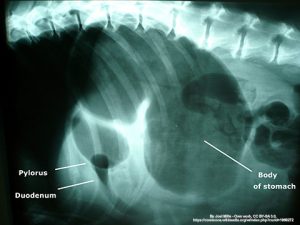
What is GDV and how can it affect my dog?

A GDV is one of the most serious emergencies that any dog a can suffer. The survival rates if not rapidly diagnosed and treated are really low, but rapid emergency surgery can genuinely save lives

What is a GDV?

GDV stands for Gastric Dilation and Volvulus. It occurs when the stomach fills with gas (Dilation or Bloat) and then twists on itself (Volvulus or Torsion). As it twists, it traps the gas inside; this also blocks the blood vessels returning blood to the heart, meaning that dogs with a GDV rapidly go into shock. As the body is starved of oxygen (due to the shock state), tissues start to die, releasing potassium into the blood vessels. This can slow and stop the heart. This is a real, top-priority emergency as affected dogs can die within an hour or so of first showing symptoms.

What causes it?

The exact cause isn’t known for certain, but we do know that deep-chested dogs (e.g. Setters or Great Danes) are at increased risk; there also seems to be a genetic component as animals who have a litter-mate who suffers a GDV are more likely to develop one themselves. In addition, exercising vigorously immediately after eating also seems to be a risk factor.

What are the symptoms?

In most cases, the dog initially appears restless or uncomfortable; then they begin to retch. This is usually without actually producing anything, although in some cases some frothy foam may appear. This is a “red-flag” danger sign! Soon afterwards, you may notice the abdomen (tummy) beginning to expand and bloat, and they will then rapidly show signs of shock with pale gums, weakness, fast heart rate, and collapse. Once the dog is has reached this stage, the prognosis is poor, and many dogs actually die on their way into the clinic.

How do your vets diagnose it?

The symptoms are usually pretty clear, however, an X-ray will confirm the diagnosis if necessary.

How can it be treated?

The immediate first aid that our veterinary team will perform is to try and pass a stomach tube and let the gas out of the stomach. This won’t fix the problem but will buy ten to twenty minutes to get them stable enough for surgery. If the dog is in severe distress, but it isn’t possible to pass a tube past the twist in the stomach, the vet may be able to use a needle to release the gas.

The biggest problem with this condition is how unstable these dogs are – most GDV dogs are so sick on arrival that anaesthesia for surgery could easily be fatal. It’s necessary to treat the shock (with massive doses of intravenous fluids) and bring their blood potassium down into the safe range (usually with fluids, although sometimes medications may be used as well) before they can be operated on. Once they are in a better physiological state, we’ll rush them into theatre, and the vet will open the abdomen and decompress the stomach. If any part of the stomach has been starved of blood for too long and has died, we’ll remove these sections. Likewise, it is sometimes necessary to remove the dog’s spleen if it has become twisted as well.

The next phase is to fix the stomach to the abdominal wall so it cannot twist again in the future – this is called a gastropexy. In fact, if you have a very high-risk dog, we can perform this as an optional (non-emergency) treatment, typically at the same time as neutering, to prevent them developing a GDV in the future.

A dog who has had GDV surgery will usually need a while as an inpatient in intensive care to recover; however, if they make it through surgery, the prognosis is usually fairly good.

What’s the prognosis?

According to the latest research, about 60% of dogs with a GDV will die. However, if they are stable enough to be operated on, the majority of these (80%) will survive. The take-home message is that the earlier they’re seen by our vets, the more likely it is that they’ll come home – so don’t delay!

If you think your dog MIGHT be showing signs of a GDV, call us IMMEDIATELY!

Why does my old dog struggle when he’s going to the toilet?

Could he have a prostate problem? 

There are a number of possible reasons older dogs can struggle to pass faeces, but yes, a prostate problem is quite possible, especially if he’s entire (not been neutered). 

So, what could be causing it?

Firstly, I’m afraid, we need to define what “it” is! Is he passing normal faeces, and just taking longer about it? Are his faeces really hard and dry, or an unusual shape? Does it seem to be painful for him, and if so, is there blood in the poo? These questions will really help to work out what’s going on – but any problem going to the toilet needs checking by your vet, as some of these conditions need professional attention.

Constipation is a fairly common problem in dogs – it is usually due to diet – especially eating things they shouldn’t! Foreign materials, such as cloth or soil, may ball up in the lower intestine (assuming they don’t cause a blockage further up); and chewed up bone can form a “faecolith” – a solid “rock” of bone powder, preventing normal pooing. Other problems may be too little (or even too much!) fibre in the diet. Lack of exercise is also a possible cause – many dogs can’t move their bowels effectively without exercise. If your dog isn’t getting out for a walk and/or a run regularly, some degree of constipation is often the result.

Constipated dogs strain to pass faeces, and what does come out is often dry and hard.

Obstipation is much more serious, and it’s where constipation goes untreated. The colon becomes completely jammed with material and unable to function. Often, this results in vomiting as well as constipation as food in the gut becomes “backed up”.

Nerve damage can lead to difficulty pooing, but it’s uncommon. Obviously, if you suspect your dog has a spinal problem, contact us as soon as possible!

Arthritis is another cause of these symptoms in dogs, and one most people don’t even think about. Dogs can’t go to the toilet normally unless they can squat; if their joints are stiff and sore, they may struggle to go normally.

Prostate disease is very common in older entire male dogs (obviously, bitches are immune…). The most common problem is benign prostatic hyperplasia (or BPH) – a simple enlarged prostate gland, caused by the action of testosterone. As the gland enlarges, it pushes on the rectum, making it harder for the dog to push faeces out; this often has the effect of producing “ribbons” of poo, which are flattened by the obstruction. BPH cannot happen in a neutered dog – no testicles = no testosterone, so the prostate shrinks and becomes inactive.

Other problems that some dogs may suffer from are prostatitis – this is an infection of the prostate, and often results in painful defecation, and sometimes difficulty urinating. It also tends to result in blood or even pus in the urine and semen; and if the dog is standing at stud, you may notice he seems to lose his sex drive because ejaculation is so painful.

Occasionally, dogs may suffer from prostatic tumours, although they’re pretty rare.

So what can be done?

Well, first of all you need to know what the problem is! That means you need to bring him in so one of our vets can check him over.

Simple constipation can often be resolved with a mild laxative and a change in diet. If the cause is lack of exercise, treatment is easy enough – get him out more!

Obstipation, on the other hand, needs more aggressive treatment, with laxatives and an enema under sedation or anaesthesia (essentially, we wash out the rectum and colon, usually with soapy water).

Spinal lesions need more aggressive treatment, usually in a specialist referral centre.

If your dog is arthritic, sadly, it cannot be cured; however, there are supplements and medications that may slow down its progression, and modern painkillers can make him comfortable again.

Prostate problems can almost always be improved by castration – no more testicles = no more problem. If this, for whatever reason, isn’t an option, there are drugs that mimic the effects of castration, without surgery, and will likewise cure BPH. Prostatitis is almost always a result of BPH – antibiotics and occasionally surgical drainage of the prostate are needed to treat the infection, but without castration (surgical or chemical) it’ll keep coming back. Sadly, there are very few effective treatments for prostate tumours, but we can usually make the patient more comfortable and manage the symptoms.

So, if your dog is constipated – get him down to us and our vets will check him over and see what we can do to fix it.